
Video Preview
The History of Slot Machines, Rules And Strategy
Learn How to Play
My Cryptogambler Take about Slot Machines
When someone walks into a casino for the first time, whether it’s a huge Las Vegas floor full of lights or just an online casino on their phone, almost the same thing happens every time. People usually do not start with poker. They do not head straight to roulette. They do not sit down at blackjack first either. More often than not, their first stop is the slot machines, or simply slots as most people call them. And honestly, that is not surprising.

Slot games did not become the most popular form of casino entertainment by accident. On average, casinos generate around 70 percent of their revenue from slots, which makes them the biggest category in gambling. When I watch new players, I understand exactly why.
- Slots do not require long explanations.
- They do not require strategy.
- They do not require you to play against other people.
Everything is very simple.
- You choose your bet.
- You press Spin.
- And you wait to see what lands on the reels.
But that is the interesting part. Behind that simplicity is a very long story.
Slot machines first appeared more than 130 years ago, when the earliest mechanical machines started showing up in bars and saloons. The technology we use today in modern online slots actually grew out of those mechanical devices from the late nineteenth century. That is why slots are not just a game.
For players who want not only to understand the history of slot machines, but also to move directly into modern slot games with bonuses, free spins, and tournament mechanics, the next logical step is choosing the best places to play slots:
For crypto-native slots with provably fair originals alongside the standard library, Tower.bet carries 12,000+ titles and runs its own in-house games at up to 99% RTP.
This is a small piece of casino history that has survived mechanical levers, electromechanics, video slots, and now lives on in the digital world. And when you press the Spin button today, you are essentially continuing a story that began more than a century ago.
If raw slot selection is what you're after, XsBets carries one of the largest libraries I've tested, over 12,000 titles from 90+ providers in one place.
Platforms like Vavada and Acebet let you filter slots by provider directly in the lobby, which makes finding high-RTP titles from specific studios much faster.
Now I’ll tell you how it all began.
VAVADA
- +100% on First Deposit
- +100 FS on Slots
7Bit Casino
- 325% up to 5.25 BTC + 250 Free Spins
- Top Slot Reviews & Demo Games
HellSpin Casino
- Gates of Olympus Super Scatter
- 100% up to €120 + 120 Free Spins
The First Slot Machines, Where It All Began
The history of slot machines begins long before online casinos and flashy video slots. The earliest predecessor of the modern slot machine appeared in 1891 in New York. That was when the company Sittman and Pitt created a machine that many gambling historians consider the first real step toward the modern slot. This machine was inspired by poker. Inside, it had five rotating drums and around fifty card symbols representing a standard deck of cards. A player would insert a coin, pull the lever, and watch the drums stop. If a strong combination appeared, such as a pair or a full house, the player would receive a prize. But not cash.
Most of the time, the bar or saloon would hand out a cigar, a drink, or a free serving of alcohol. That was how this early form of gambling worked. But the machine had one major limitation. It could not pay winnings automatically. Every prize had to be given manually by the owner or bartender. That made the game less convenient and limited how far it could spread.
That problem was solved not long after by the next inventor, the man who effectively created the first true slot machine.
And that is where the story of the famous one armed bandit really begins.
Charles Fey and the Liberty Bell (1895)
The real turning point in the history of gambling machines came in 1895.
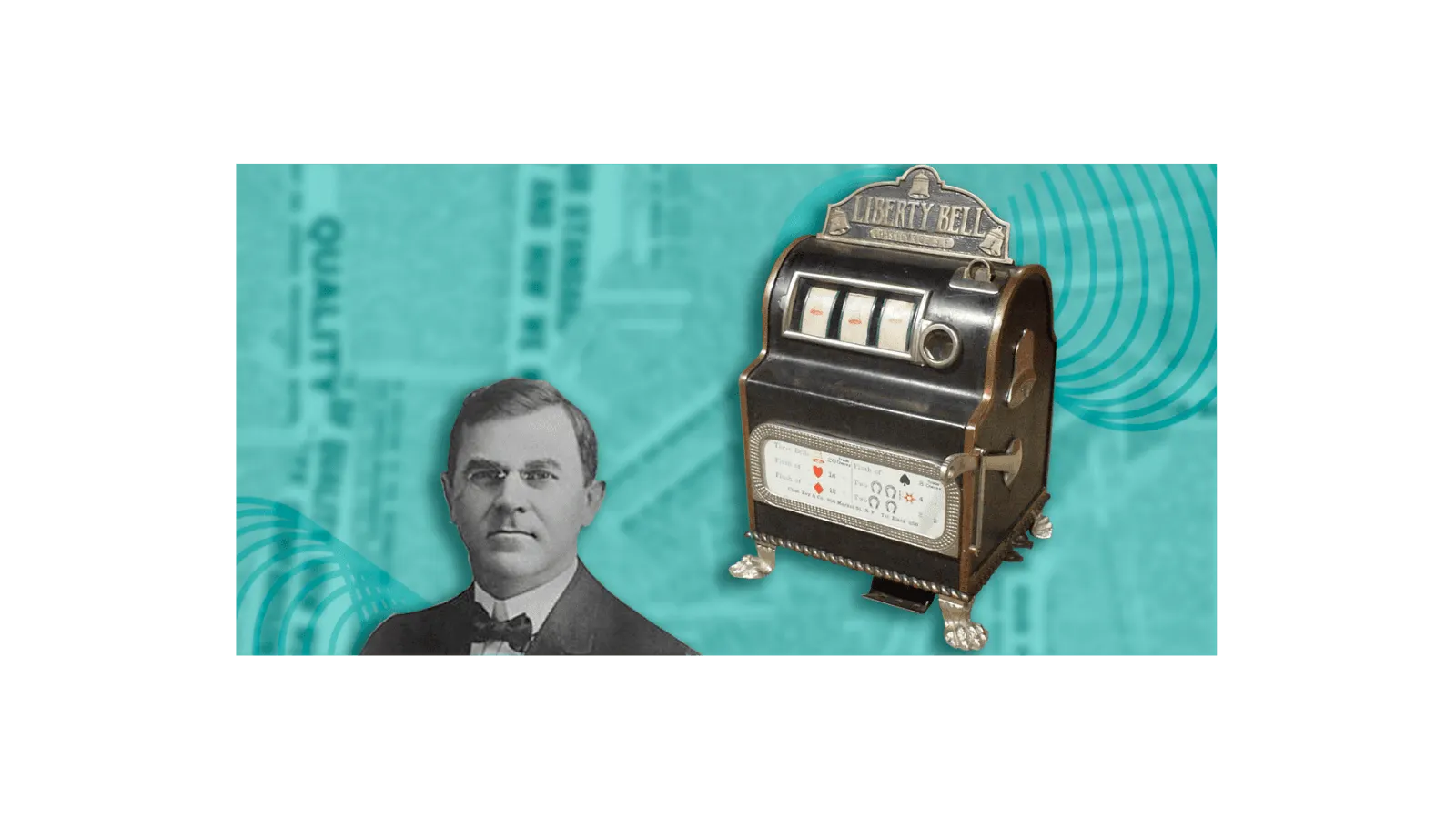
That was the year a San Francisco mechanic named Charles Fey created what is widely considered the first real slot machine. His invention was called Liberty Bell. Whenever I read about gambling history, this is always the moment that feels like the real starting line. Machines existed before Fey, but Liberty Bell was the first one to combine simple mechanics with an automatic payout system. The design was surprisingly straightforward.
Inside the machine were three spinning reels.
The reels displayed five symbols:
- hearts
- spades
- horseshoes
- diamonds
- and the famous Liberty Bell symbol
The player inserted a coin, pulled the lever, and the reels began to spin. When they stopped, the symbol combination determined the result. But the biggest innovation was something else. The machine paid out automatically. That was a huge technological difference compared to earlier machines, where prizes had to be handed over manually by a bartender or owner.
The top combination in Liberty Bell was very simple:
- Three bell symbols
That combination paid out 50 cents, which at the time was equal to ten nickels. For the late nineteenth century, that was a very noticeable win. That mechanic became the foundation for the entire future slot industry.
- Three reels.
- Simple symbols.
- A combination determines the payout.
More than a century has passed. Technology changed. Video slots appeared. Bonus rounds became more complex. Progressive jackpots entered the picture. But if you look closely, the core idea is still the same. Even today, many modern slots still follow the basic three-reel logic Charles Fey introduced.
Sometimes the simplest inventions last the longest.
Why Slot Machines Were Called the One Armed Bandit
If you have ever heard the old casino phrase One Armed Bandit, it almost always refers to slot machines. That nickname appeared back in the era of early mechanical slots and came from two main features of those old machines. The first reason was purely mechanical. Early slot machines had a metal lever on the side of the cabinet. The player inserted a coin and pulled that lever to start the reels. From the outside, it looked like the machine had one arm that launched the game. That is why they became known as one armed machines.
But there was also a second, more ironic reason.
Slot machines often took players’ money, especially when a winning combination did not show up for a while. People joked that the machine was robbing their wallet like a real bandit. That is where the word bandit came from. Put those two ideas together and you get the famous expression One Armed Bandit. What I find interesting is that even today, when most slots are fully digital and have no physical lever at all, the name still survives as part of casino culture. And every time I hear it, I think of those old mechanical cabinets with the heavy lever and the metallic sound of spinning reels.
The Origin of Classic Slot Symbols
In the early 1900s, new symbols began appearing on slot reels, and that was connected to the Bell Fruit Gum Company. The symbols matched gum flavors, which is why fruit images started appearing on slot machines in the first place. That is how the classic slot symbols became established in the industry:
- Cherry
- Lemon
- Orange
- Watermelon
These images quickly became recognizable and gradually turned into a visual tradition in slot gaming. Even today, when modern online slots can have complex 3D symbols, animated characters, or full storylines, fruit icons still appear in slot games. They are a small historical trace from the era when these machines were trying to look less like gambling and more like harmless gum dispensers.
The Electromechanical Revolution (1963)
By the early 1960s, the slot machine industry was already well established, but most machines were still completely mechanical. The reels spun using springs and mechanical parts, and payouts were limited by the physical design of the machine itself.
The real technological leap came in 1963.
That was when Bally introduced a new machine called Money Honey. It is widely considered the first mass-produced electromechanical slot machine. For the industry, this was a major shift. Money Honey no longer relied entirely on mechanical components. Electrical parts were now used to control the payout system. Because of that, the machine gained several new capabilities. It could automatically pay out up to 500 coins, which was far more than earlier mechanical slots could handle. On top of that, the use of electrical systems made the games more reliable and more flexible.
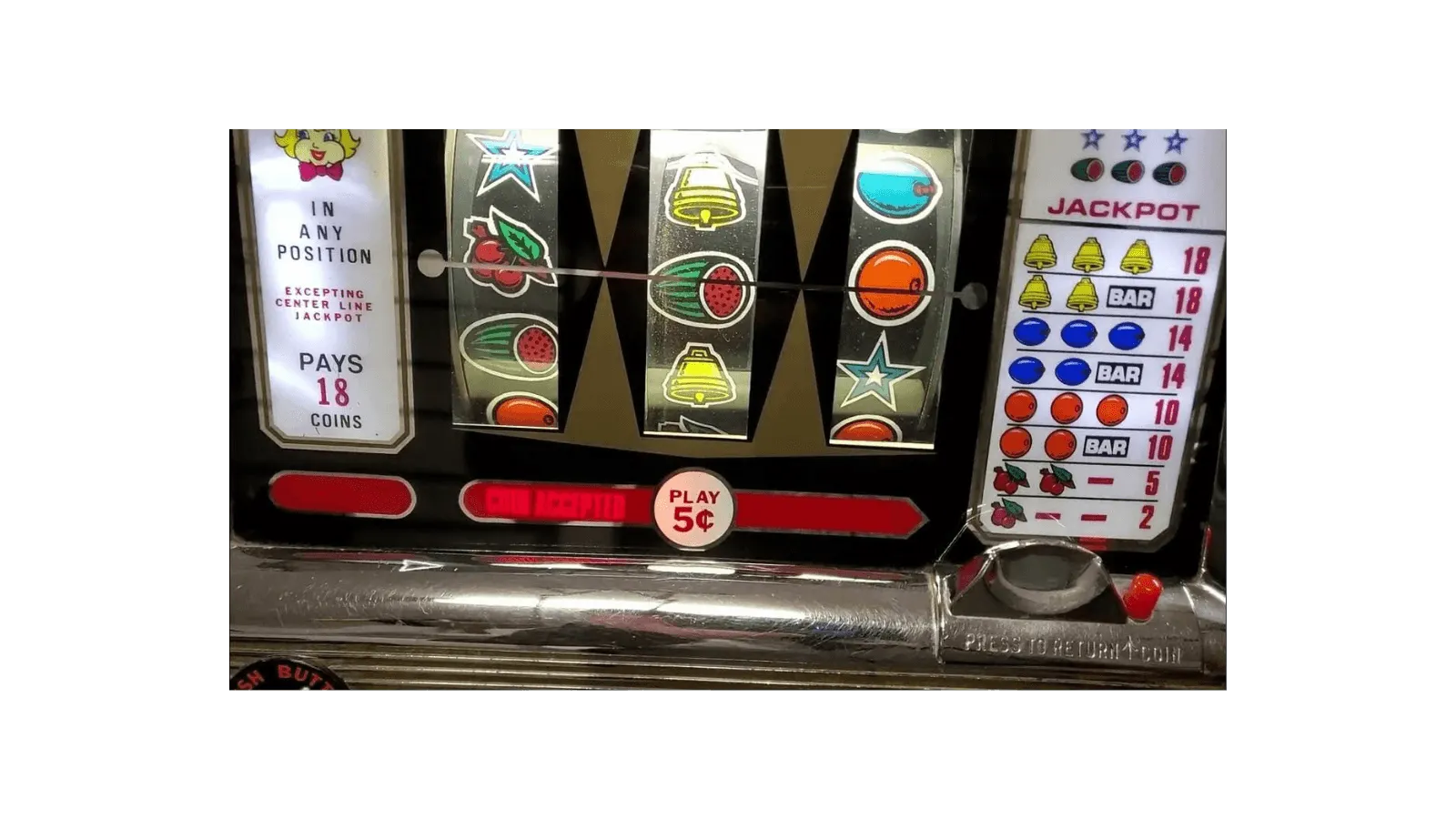
From that point on, the industry slowly started moving away from pure mechanics. Slot machines were becoming electronic gaming devices.
The First Video Slots (1976)
The next major stage in slot development came in 1976. That was when Fortune Coin developed one of the first video slot machines, using a screen instead of physical reels. Rather than relying on a traditional mechanical setup, the machine ran through an electronic system and displayed the reels on a Sony video monitor. For its time, that looked almost futuristic.
Inside this type of machine, there was already:
- a screen used to display the reels
- electronic logic to process results
- digital control of the gameplay
This was effectively the moment when slot machines started transforming into electronic video games inside casinos. At first, many players did not trust them. People were used to seeing real reels. But over time, video slots proved that they worked, and eventually they became the industry standard. Most slot games today are essentially descendants of that technology.
The Rise of Online Slots (1990s)
The next revolution did not happen on casino floors at all. It happened on the internet.
In the 1990s, as the internet expanded and the first online casinos began to appear, online slots arrived. At that stage, mechanical reels disappeared completely. The gameplay was now controlled by software code. The foundation of modern slot games became a technology known as RNG, or Random Number Generator. This is an algorithm that constantly generates random numbers. When the player presses Spin, the system selects one of those numbers and uses it to determine the outcome of the spin.
That means several important things:
- Every spin is completely independent.
- The result is determined by a random number.
- Previous spins do not affect the next one.
RNG is what made online slots possible and allowed casinos to create thousands of different games.
How Modern Slot Machines Work
Today, slot games look completely different from their mechanical ancestors. A modern slot is no longer just a set of spinning reels. Many games have become full interactive entertainment products.
Developers started adding:
- storylines and game worlds
- bonus levels and mini-games
- progressive jackpots
- tournaments and player competitions
- more complex mathematical mechanics
One of the best known innovations of recent years is the Megaways system, which can create up to 117,649 ways to win on a single spin. The Megaways mechanic was developed by the Australian studio Big Time Gaming in 2016 and was first used in the game Bonanza. The system became so popular that many major studios began licensing it for their own games. In practice, modern slot games became something halfway between a casino game and a video game. And if you look at the full journey of the industry, it becomes obvious:
Slot machines have gone through an incredible evolution. From a simple mechanical device with three reels to complex digital games with thousands of combinations and millions of possible outcomes.

The Mathematics Behind Slots
When I test any slot for a review on Cryptogambler, I do not just look at graphics or bonus rounds. What interests me first is the math behind the game.
Almost every modern slot can be understood through three key parameters:
- RTP
- Volatility
- RNG
If you understand these three things, you already understand most of how a slot machine actually works.
But theory becomes most powerful when applied in practice. That is exactly why experienced players usually look for casinos with a strong slot library, where they can compare RTP, volatility, and bonus mechanics in real conditions.
Now let’s break them down one by one.
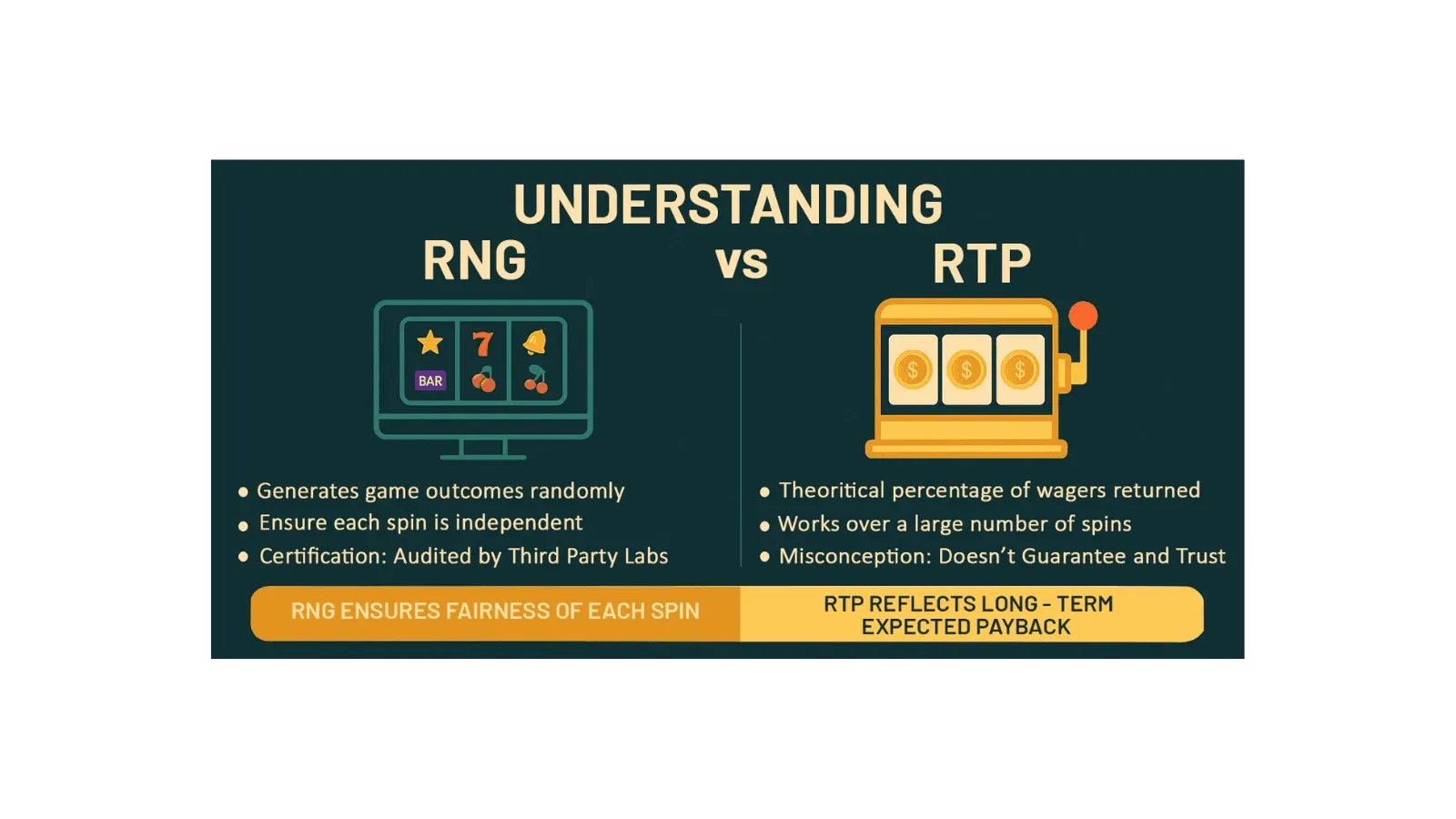
RTP (Return to Player) shows what percentage of all wagers a slot theoretically returns to players over the long term. Simply put, it is the mathematical payout model of the game. For example, if a slot has an RTP of 96 percent, this means:
• If players wager $1,000 in total, approximately $960 will statistically return to players as winnings over time
• Around $40 will remain with the casino
But there is one critical thing to understand.
RTP only works over a very large sample size. We are talking about thousands or even millions of spins. In a real gaming session, everything can look completely different. Over a short period, a slot may deliver a huge win or completely drain your bankroll. That is why RTP should not be viewed as a guarantee of results, but as a long-term mathematical characteristic of the game.
Modern slot games operate using RNG (Random Number Generator) technology. This is a special algorithm that continuously generates random numbers, even when nobody is playing. When a player presses the Spin button, the system simply takes one of those random numbers and uses it to determine the outcome.
This means several very important things:
• Every spin is completely independent
• The slot does not remember previous results
• Previous losses or wins do not affect the next spin
Some players believe that after a long losing streak, a slot is “due” to pay out soon. In practice, this is not true. Every new spin starts from a clean slate.
Does this mean you can hit a huge win on your very first spin?
Yes, theoretically - absolutely.
If a slot uses certified RNG, every spin is independent. This means:
• The first spin has the same jackpot odds as the thousandth spin
• A losing streak does not increase your chances of winning
• A winning streak does not reduce your chances of landing another big payout
Simply put: a massive win can happen on your very first spin after registration, or after 5,000 spins.
The third major parameter of a slot machine is called volatility. It determines the frequency and size of payouts. Slots are generally divided into two main categories.
Low Volatility
These games pay out more frequently, but the winnings are usually smaller. This creates a more stable and steady playing style.
• Frequent wins
• Smaller payouts
High Volatility
These slots may go long periods without major wins, but their payout potential is significantly higher.
• Rare wins
• Potentially massive payouts
That is exactly why high volatility slots are often chosen by players who want to maximize bonuses, free spins, and modern slot mechanics with the hope of landing a bigger score.
When I test a slot for review purposes, I always try to determine the game’s real volatility. This helps identify what type of player the slot is best suited for.
• Some games are designed for long sessions and steady smaller wins
• Others are built around rare but much larger payouts
Understanding volatility helps players choose a slot that actually matches their personal style.
If you compare different casino games, slot machines remain one of the simplest and most understandable categories. When I watch new casino players, I almost always notice the same pattern: people understand slot mechanics within seconds, and that is no accident.
The core logic of slot games is extremely simple:
• The player chooses the bet size
• Presses the Spin button
• The reels begin to spin
• After they stop, the system checks the symbol combination
If the combination matches the game’s rules, the slot pays out winnings.
This simplicity is exactly what made slot machines the most popular casino game in the world.
Although the base process is straightforward, modern slot games use different payout mechanics. The most common systems include:
Paylines
Classic payout lines. Symbols must align across specific lines to create a winning combination.
Clusters
Instead of paylines, the game looks for groups of matching symbols connected next to each other.
Ways to Win
Traditional paylines effectively disappear. Wins are formed when matching symbols land on adjacent reels.
Scatter Symbols
Special symbols that can trigger bonus features regardless of paylines.
Bonus Rounds
Additional game rounds that may include:
• Multipliers
• Mini-games
These mechanics are what make modern slot games far more diverse than old-school three-reel machines.
In classic slot machines, the number of paylines was limited by physical reel structures. Today, the situation is completely different. Modern slots can use various mathematical models, including:
• 10 Paylines
• 25 Paylines
• 243 Ways to Win
• Dynamic systems like Megaways
Megaways, in particular, is considered one of the most mathematically complex formats used in the slot industry today.
Interesting Facts About Slot Machines
Over more than a century of history, slot machines have accumulated a huge number of interesting details. Some of these facts surprise even experienced players.
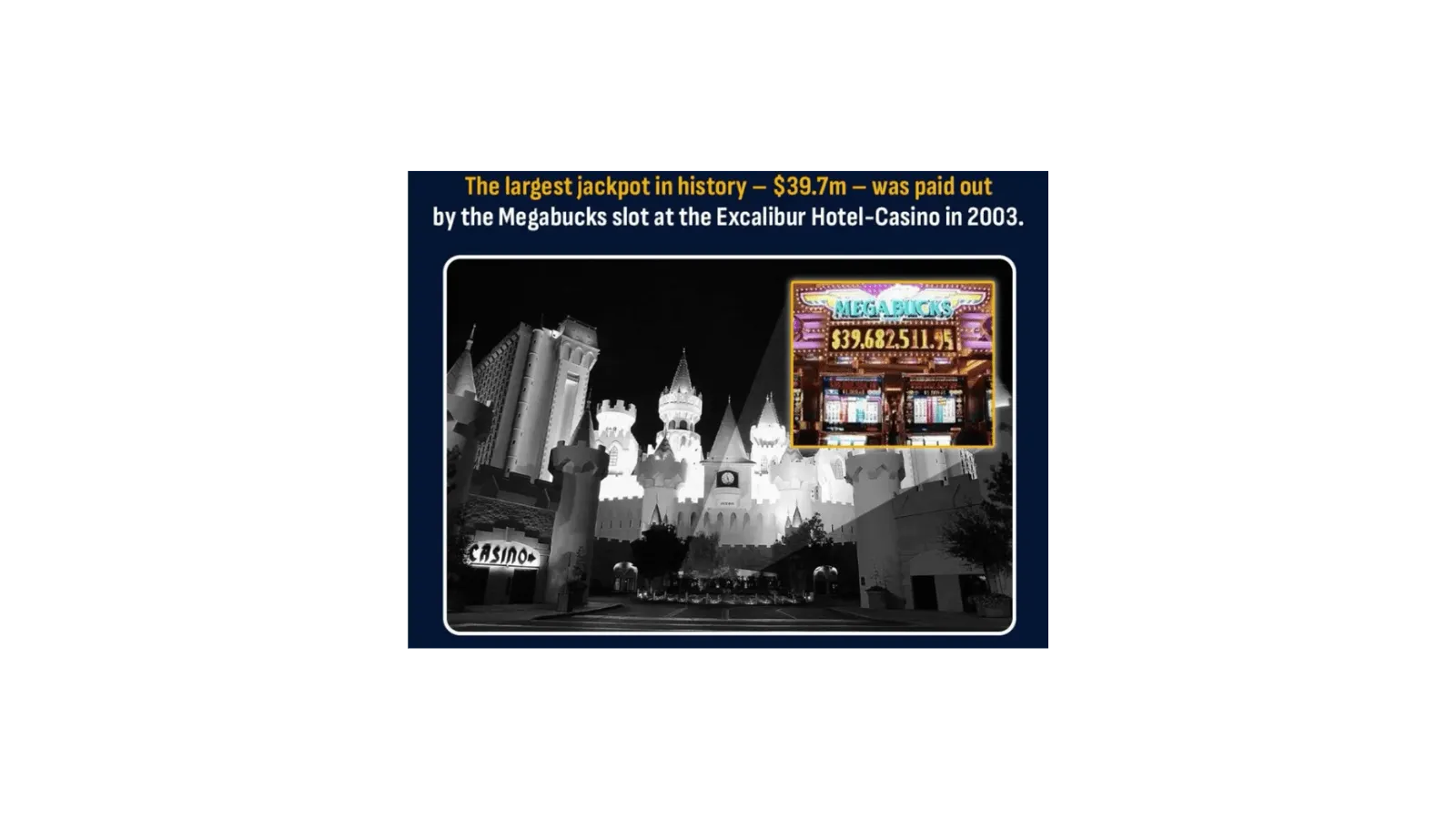
One of the biggest slot wins in history happened in 2003 at the Excalibur casino in Las Vegas. An engineer from Los Angeles, Johannes van Oort, won more than 39 million dollars on the Megabucks progressive slot from IGT.
Slot machines generate the main share of casino revenue. In some venues, slots account for around 70 percent of casino profit.
The chance of hitting a major progressive jackpot can be roughly one in seventeen million spins. In terms of probability, that is comparable to lottery level odds.
The very first slot machine, Liberty Bell, paid a maximum of only 50 cents. Today, the largest progressive jackpots can exceed ten million dollars.
The industry has gone from a simple mechanical box to highly advanced mathematical systems.
If you look at the history of slot machines, it becomes obvious just how long a road this industry has traveled. Once, it was a simple mechanical box with three reels. The player dropped in a coin, pulled the lever, and hoped for a lucky combination. Today, slot games look completely different.
Modern games use complex mathematical models, digital algorithms, and graphics that can feel closer to video games than classic casino machines. A single slot can contain thousands of possible combinations, bonus stages, multipliers, and progressive jackpots. But if you strip away the visual layer, the foundation is still almost the same:
- randomness of the result
- simplicity of the gameplay
- instant outcome on every spin
That combination is exactly what makes slot machines so popular. The player does not need to study complicated rules. They do not need to compete against other people. They just choose a bet and start the spin. That is why it is no surprise that slots remain the most popular category of casino games in the world.
Authored by Cryptogambler Final Thoughts
As someone who has tested casinos and game mechanics for many years, I always come back to the same conclusion. Slot games can be great entertainment but only if the player understands how they work and plays with discipline.
For me personally, this was also an interesting story to explore. I’ve always enjoyed looking far into the past and thinking about the future at the same time. Slot machines started as simple mechanical boxes in small bars and saloons more than a century ago, and today they have become complex digital games played by millions of people around the world.
It makes you wonder what comes next. Technology keeps evolving, and the slot industry evolves with it. New mechanics, new game worlds, new mathematical models every decade seems to bring something different.
And that raises an interesting question.
What will slot games look like in the future?
Cryptogambler


