

Plinko Review 2026 - RTP, Mechanics and Max Win
Learn How to Play
Plinko - official mechanics, RTP and demo review
Plinko is a provably fair casual game with 8 to 16 rows, three risk levels and manual or automatic ball drops, topped by a 1,000x multiplier.
Play Plinko at VAVADA
- BGaming casual games catalogue
- Desktop and mobile browser access
How Plinko Works
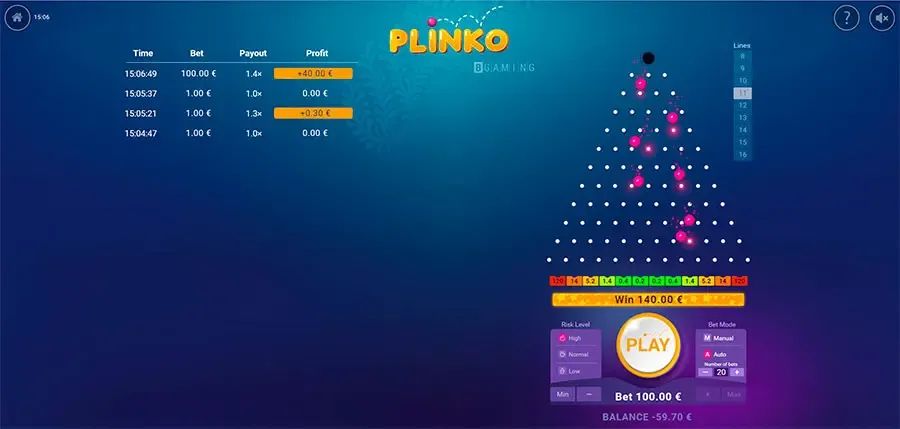
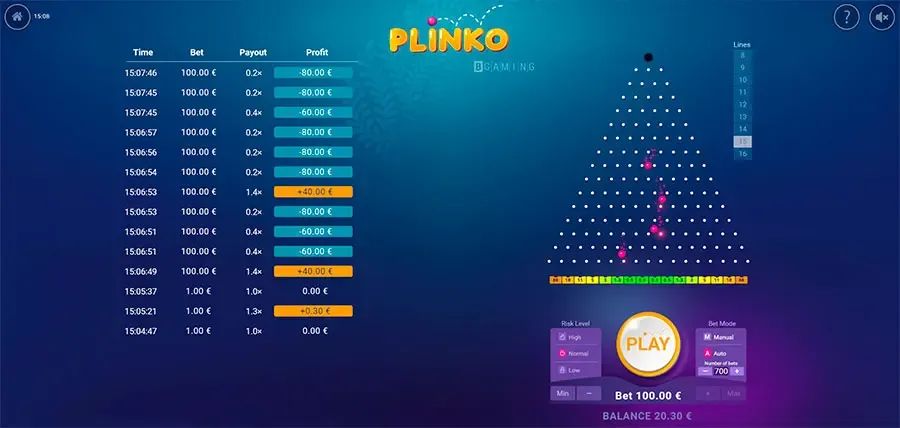
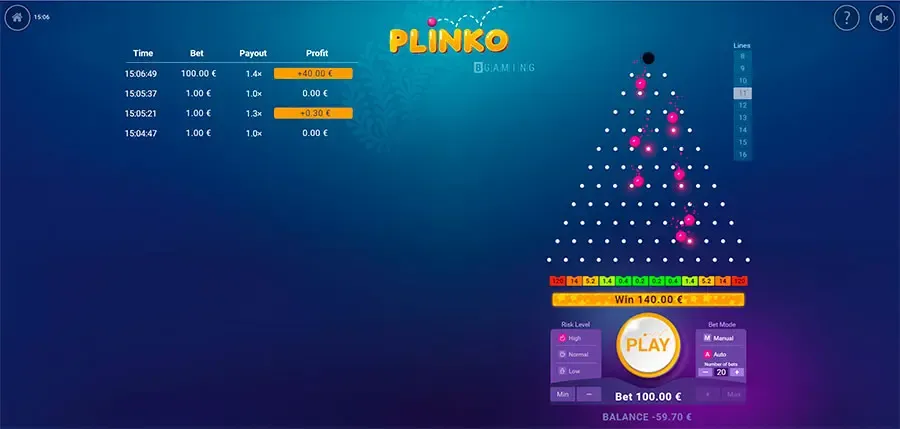
Set the stake, select 8 to 16 rows and choose low, normal or high risk. A ball drops through a pyramid of pegs and lands in one of the multiplier cells at the bottom. Central cells generally carry the calmer values, while the largest multipliers sit near the edges and become harder to reach. Manual mode releases one ball at a time. Auto mode repeats the same selected configuration for the chosen number of balls.
Reading the Result
The balance, complete stake and latest result are displayed separately. A larger animation is not an additional payment unless it appears in the final round total. Every round is generated independently, so a sequence of losses does not make the next feature or large multiplier due.
Official Game Profile
BGaming classifies Plinko as a casual game. It was released on 2019-01-28, with a published RTP of 99%, adjustable volatility and a maximum of 1,000x. These are long-run specifications, not a prediction for one session.
Features and Special Controls
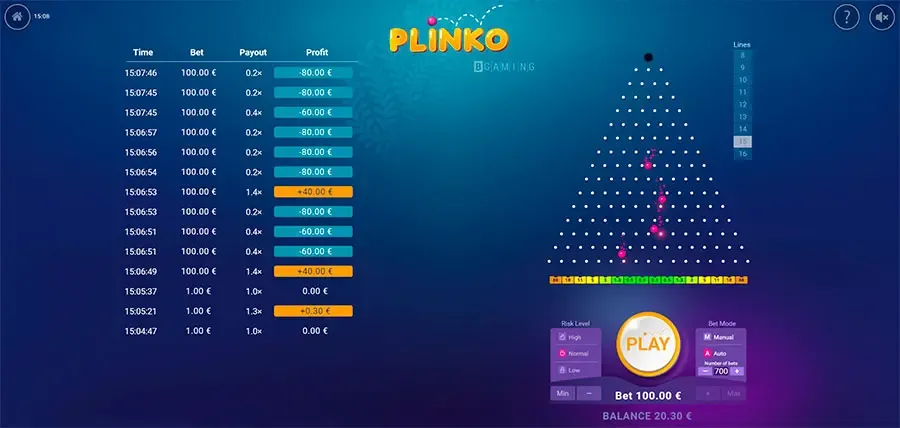
Plinko has no free-spins round or reel bonus. Its meaningful controls are the row count and risk profile. Increasing either changes the multiplier table and the distribution of outcomes, not the path of a ball already in motion. A results panel records previous stakes, payouts and profit or loss. BGaming describes the game as provably fair, allowing a completed round to be checked through server and client seeds.
RTP and Configuration Checks
The published RTP is 99%. The affiliate dashboard and the game information screen can show a market-specific configuration, so the value inside the loaded version is the relevant one. RTP describes a theoretical return over a very large number of rounds. It does not promise that a short session will return the listed percentage.
Maximum Win and Cash Cap
The official multiplier ceiling is 1,000x. BGaming lists the cash cap as configuration dependent. If both limits could apply, the lower payout is the practical ceiling. Maximum-win examples are useful for explaining the rules, but they should not be used as a bankroll target.

What to Test in Demo Mode
Run separate samples for low, normal and high risk without changing the stake. Use the same number of rows and at least 100 balls in each sample. Compare how much of the return comes from common central cells and how much depends on rare edge landings. Do not mix different settings in one sample because the multiplier table changes with them.
Demo play is most useful when the sample has a fixed stake and a written round count. Record the total committed, the total returned and the mechanic responsible for each larger result. Stopping immediately after a highlight creates a distorted impression of pace and cost.
Mobile and Desktop Experience
The HTML5 version runs in supported desktop and mobile browsers. Desktop offers more room for counters, histories and help panels, while mobile keeps the primary controls close to the game area. Mathematical rules do not improve or worsen with screen size.
What Makes Plinko Different
Unlike slot reviews, Plinko is best understood as a configuration game. The player chooses a distribution before the drop, but cannot steer the ball afterward. The visible peg path explains where the multiplier comes from, and the history panel makes short samples easy to audit without suggesting that previous results affect the next ball.
Responsible Session Planning
Decide a cash limit before starting and include every optional mode in that limit. Increasing speed or using autoplay can compress more paid rounds into the same amount of time. Neither option changes the expected value. A timer and a maximum loss are more useful controls than chasing a previous result.
Final Verdict
Plinko is a provably fair casual game with 8 to 16 rows, three risk levels and manual or automatic ball drops, topped by a 1,000x multiplier. The official materials make its key mechanism easy to verify, and the demo is sufficient to understand the rhythm before any real-money decision. The best fit is a player who enjoys the specific control described above and keeps the full round cost visible.
This review is based on BGaming's official game page, affiliate dashboard, rules and media. Availability, optional controls and RTP configurations can vary by market and operator.
Frequently Asked Questions


